Machine Learning for the Characterization and SustainabilityPrediction of Solidarity Economy Organizations in Latin America
Palabras clave:
Social and Solidarity Economy; Machine Learning; Clustering; XGBoost; SHAP; Sustainability Prediction; Cooperatives; Latin America; Interpretable AIResumen
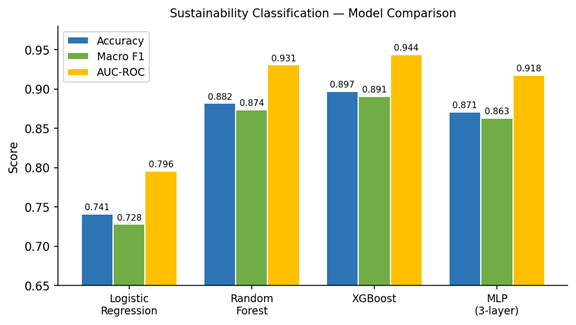
The Social and Solidarity Economy (SSE) encompasses cooperatives, mutual associations, community enterprises, and barter networks that prioritize social value over profit maximization. Despite its growing policy relevance in Latin America, SSE organizations lack data-driven tools for sustainability assessment and typological characterization. This paper proposes an end-to-end machine learning framework—SSE-ML—for clustering SSE organizations into actionable typologies and predicting their three-year sustainability based on 30 socioeconomic, governance, and operational indicators. Applied to a dataset of 1,847 registered SSE organizations from five Latin American countries, unsupervised K-Means clustering identifies five distinct organizational typologies, while supervised XGBoost achieves Accuracy = 0.897, Macro F1 = 0.891, and AUC-ROC = 0.944 for sustainability classification. SHAP-based explainability reveals that years of operation, number of associates, and democratic governance index are the strongest predictors. The framework provides public-policy practitioners with an interpretable, evidence-based tool for resource allocation and organizational support in SSE ecosystems.
Publicado
Número
Sección
Licencia
Derechos de autor 2026 Neutrosophic Computing and Machine Learning

Esta obra está bajo una licencia internacional Creative Commons Atribución 4.0.