Eight Years of Neutrosophic Computing and Machine Learning: a Bibliometric Retrospective and a Neutrosophic Extension to Bibliometric Analysis (2018–2026)
Palabras clave:
bibliometrics; neutrosophic logic; single-valued neutrosophic numbers; SVNWA aggregation; Lotka's law; Bradford's law; h-index; co-authorship network; topic modeling; Google Scholar Metrics; open-access journals; editorial retrospective; Neutrosophic Computing and Machine LearningResumen
Neutrosophic Computing and Machine Learning (NCML) is the applied-methods journal of the neutrosophic publication ecosystem founded by Smarandache, with 42 volumes published between 2018 and 2026 (partial). No systematic bibliometric retrospective of the journal has been published, and the recent methodological critique of Woodall, Faltin and Reynolds (2025) raises three empirically-testable concerns about the neutrosophic field: methodological concentration, citational concentration, and limited external validation. This paper combines a classical bibliometric retrospective of NCML (Sections 4, 7) with a methodological contribution: the introduction of a neutrosophic bibliometric framework that promotes indeterminacy to a first-class component of measurement (Sections 3, 5).
We compiled a reproducible corpus of 762 articles through scraping, enriched with OpenAlex (671/719 DOIs) and DataCite (704/719), disambiguated 1 363 unique authors by union-find (four hierarchical rules), fitted the classical Lotka and Bradford laws, built the Louvain co-authorship network, and modeled 24 topics with multilingual embeddings plus UMAP and KMeans on 725 usable abstracts. The neutrosophic framework extends five classical indicators — h-index, Lotka exponent, Bradford zone membership, document-topic membership, and co-authorship edge weight — into single-valued neutrosophic triples (T, I, F) whose indeterminacy component is computed from the data rather than elicited from experts. The central operative test of the framework is a neutrosophic aggregated ranking of authors using the SVNWA operator.
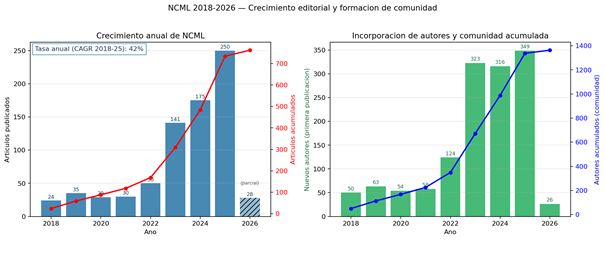
Classical results confirm a rapidly growing journal with CAGR 42% (2018-2025), a Lotka exponent α = 2.03 (K-S rejected), a Bradford nucleus of five journals concentrating 33% of citations (17% self-citation to the neutrosophic ecosystem), a co-authorship graph of modularity 0.96 with only a 16% main connected component, a topical identity shift of -21.6 pp in the education topic between 2018-2020 and 2023-2025, and an order-of-magnitude discrepancy between citation sources (Google Scholar h5-index = 10 vs OpenAlex h = 1). The neutrosophic analysis decomposes these findings: N-h-index (T = 0.04, I = 0.50, F = 0.46), N-Lotka (T = 0, I = 1, F = 0), graded Bradford nucleus membership where only two journals reach T ≥ 0.85, 61% of documents with boundary-topic indeterminacy, and only 1.8% of co-authorship edges with verified-collaboration T ≥ 0.5. The SVNWA aggregated ranking of 146 authors diverges substantially from the classical article-count ranking (Kendall τ = 0.20, top-10 overlap 5/10), a divergence unreachable by fuzzy, intuitionistic-fuzzy, or probabilistic aggregation without introducing structure equivalent to the (T, I, F) triple. The paper closes with a fifteen-recommendation editorial roadmap organised on a three-year horizon.
Publicado
Número
Sección
Licencia
Derechos de autor 2026 Neutrosophic Computing and Machine Learning

Esta obra está bajo una licencia internacional Creative Commons Atribución 4.0.