Territorial Concentration and Service Disparity of Diagnostic Procedures in Ecuadorian Public Health Facilities: A 2024 Administrative Data Assessment
Palabras clave:
Diagnostic procedures; Public health administration; Spatial concentration; Level of care disparity; Open administrative records; Ecuadorian health system.Resumen
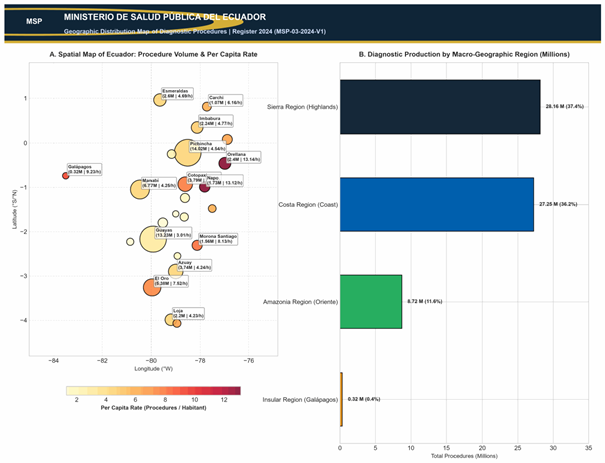
Managing diagnostic infrastructure in public health systems requires precise empirical evaluation of service volume, spatial concentration, and facility capacity. This study presents a descriptive observational analysis of the 2024 laboratory and diagnostic procedure dataset (“MSP_Laboratorio_2024.csv”) from the Ministry of Public Health of Ecuador (MSP), evaluating 29,368 administrative records across 34 variables. Quantitative zeros were distinguished from technical missingness to evaluate reporting validity. Results indicate a total national production of 75,265,081 procedures, with clinical laboratory examinations constituting 82.09% (61,781,607 procedures). Secondary care facilities (“NIVEL 2”) produced 60.06% of total workload (45,200,942 procedures), while outpatient care (“CONSULTA EXTERNA”) absorbed 54.35% (40,904,847 procedures). Absolute volume was concentrated in Pichincha and Guayas (36.20% combined), but population normalization revealed higher per capita rates in Pichincha (4.54 procedures/habitant) than in Guayas (3.01 procedures/habitant). An interactive web dashboard was deployed to support regional decision-making. These findings establish an empirical baseline for evidence-based resource allocation in Ecuadorian public health planning.
Publicado
Número
Sección
Licencia
Derechos de autor 2026 Neutrosophic Computing and Machine Learning

Esta obra está bajo una licencia internacional Creative Commons Atribución 4.0.