Neutrosophic Analysis of Competing Hypotheses (NACH): A Novel Framework for Complex Causal Modeling with Applications to Climate Change and Urban Violence
Palabras clave:
neutrosophic logic, competing hypotheses, causal modeling, climate change, urban violence, decision analysis, uncertainty quantificationResumen
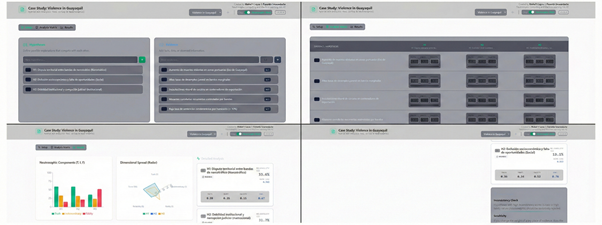
This paper introduces the Neutrosophic Analysis of Competing Hypotheses (NACH), a novel methodological framework that extends traditional intelligence analysis by incorporating neutrosophic logic to quantify indeterminacy and contradiction in complex causal systems. Unlike classical Analysis of Competing Hypotheses (ACH), which relies on binary consistency assessments, NACH employs a multiplicative reliability metric ( ) that integrates Truth, Indeterminacy, and Falsity.We demonstrate the framework's capability through two case studies in Guayaquil, Ecuador: (1) climate change impacts and (2) the surge in urban violence. The results indicate that while classical ACH tends to assign absolute certainty to leading hypotheses, NACH provides a robust 'epistemic safety margin.' In the urban violence case, the framework successfully identified 'DTO Competition' as the primary operational driver ( ), distinguishing it from structural factors like 'State Weakness,' which, despite high truth potential, was penalized for significant informational ambiguity ( ). This approach prevents premature closure and offers decision-makers a nuanced ranking that reflects the inherent 'fog of war
Publicado
Número
Sección
Licencia
Derechos de autor 2026 Neutrosophic Computing and Machine Learning

Esta obra está bajo una licencia internacional Creative Commons Atribución 4.0.