Non-Normalization Is Not Independence: An Empirical Audit of the Indeterminacy Coordinate in Five Neutrosophication Methods on Clinical Data
Palabras clave:
neutrosophication; neutrosophic sets; indeterminacy; functional redundancy; normalization; complementarity; K-means; uncertainty quantification; medical dataResumen
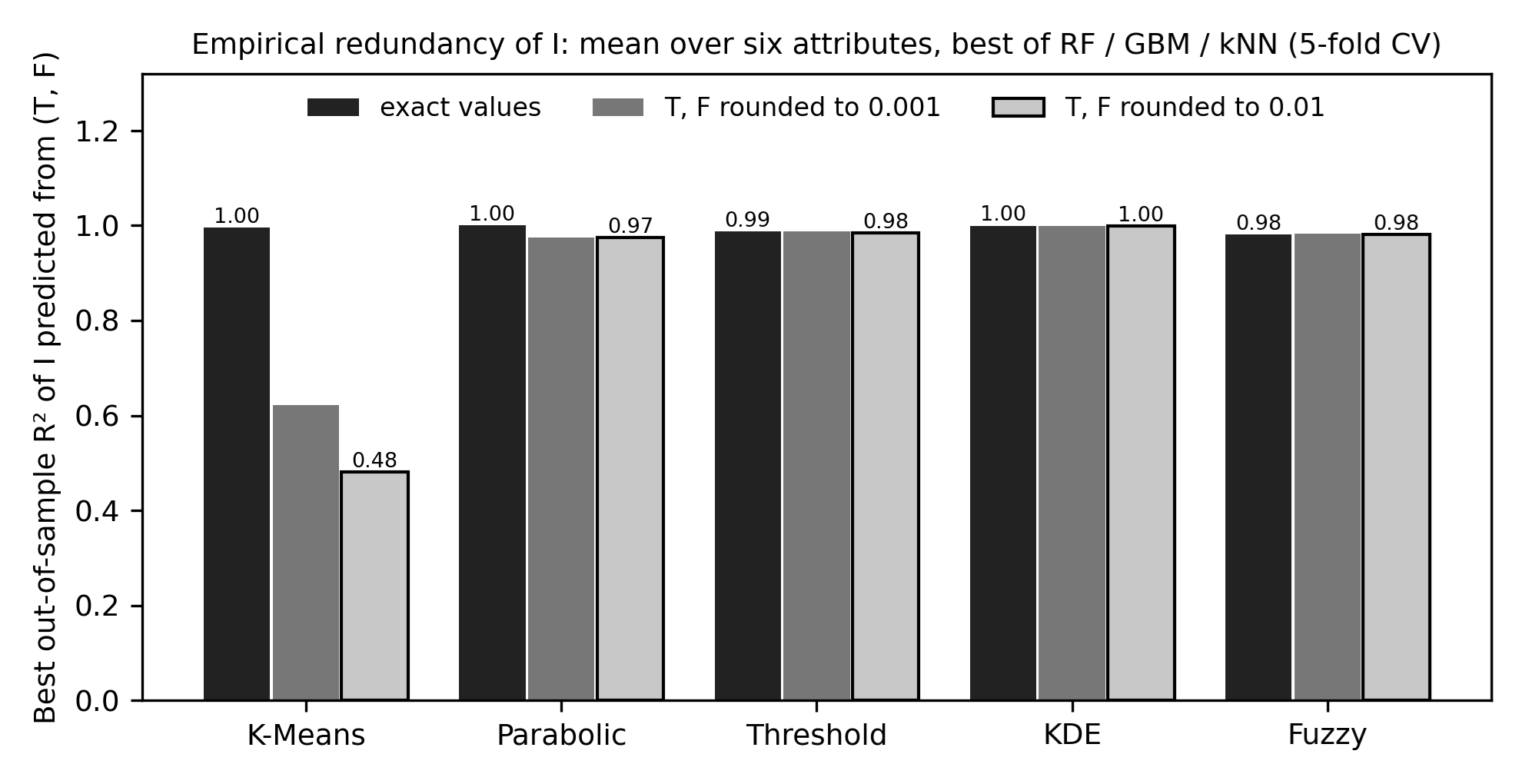
Neutrosophication converts a crisp value into a triple (T, I, F) of truth, indeterminacy and falsity degrees. A common way of arguing that a method is "truly neutrosophic" is to observe that or that . Neither observation shows that the third coordinate carries information not already contained in the other two. We audit five neutrosophication transformations (a proposed K-Means + sigmoid method, and the parabolic, threshold-distance, kernel-density and triangular-fuzzy methods) on six clinical attributes of the Cleveland heart-disease data ( ), separating normalization, complementarity, data adaptivity, empirical non-redundancy, stability and downstream utility as distinct, separately tested properties. An equation-level audit shows that all five transformations are functions of a single scalar and that four of them derive I analytically from T. Cross-validated regressions of I on (T, F) give out-of-sample of 1.00, 0.99, 1.00 and 0.98 for the four complementary methods and 1.00 for K-Means at full numerical precision, falling to 0.48 when T and F are recorded to two decimals: the K-Means coordinate is non-redundant only through the numerically negligible tails of saturated sigmoids (T, for 63 % of observations). A nearest-neighbour test confirms the pattern. In a leakage-safe, same-classifier ablation, adding I to (T, F) changed the ROC-AUC of a logistic regression by -0.009 (95 % -0.035 to +0.017) for K-Means and by at most 0.008 for the other methods, and no neutrosophic representation exceeded the raw six attributes by more than 0.006 AUC with any of three classifiers. The K-Means I correlated weakly with external uncertainty signals (AUC 0.56 against misclassification), and two ambiguity-based alternatives were not better. K-Means results were stable across seeds with k-means++ but not with the original random initialisation, and sensitive to the sigmoid slope, to the choice of K and to scaling. The main lesson is methodological: not every three-component representation contains three independent dimensions of information, and neutrosophication methods should not be evaluated by alone. Because a univariate transformation cannot add information about its input, the constructive consequence is that future indeterminacy coordinates must be grounded in separately auditable evidence (reliability, additional sources, resampling, time, modalities, agents); the paper closes with a prior-art-audited taxonomy of such evidence-grounded designs, ten design principles and a validation checklist.
Publicado
Número
Sección
Licencia
Derechos de autor 2026 Neutrosophic Computing and Machine Learning

Esta obra está bajo una licencia internacional Creative Commons Atribución 4.0.