(T, I, N, F) Neutrosophic Weak and Strong Paraconsistency and the Epistemics of Artificial Intelligence: Uncertainty, Pluralism, and the Decolonial Turn in Alignment
Abstract
Over the past two years we have developed, with collaborators across Ecuador, Cuba and the United States, a
research program arguing that the standard mathematical machinery used to represent uncertainty in artificial
intelligence is paraconsistency-intolerant: it cannot hold well-supported contradictory evidence in view without
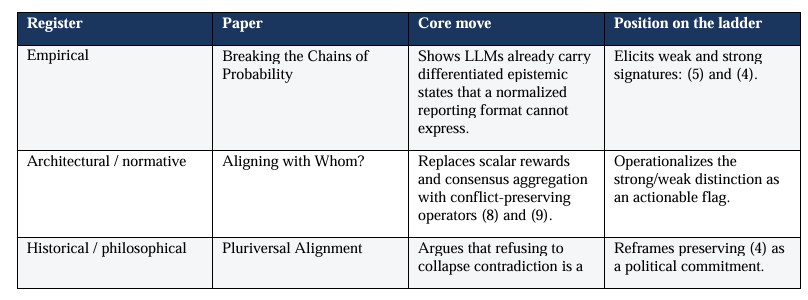
collapsing it into a single number. This paper draws together three strands of that program — an empirical study
of epistemic uncertainty in large language models (“Breaking the Chains of Probability”), a proposal for value
alignment under irreducible cultural pluralism (“Aligning with Whom?”), and a decolonial reading of
paraconsistent logic’s Latin American genealogy (“Pluriversal Alignment”) — and reads them through the (T,
I, N, F) = (Truth, Indeterminacy, Neutrality, Falsehood) Quadruple Neutrosophic Set and Logic, introduced by
Smarandache (2017) and the taxonomy of paraconsistency degrees: strong, weak, and very weak. We show that
the three papers are not merely thematically related but occupy successive layers of a single argument: a
representational critique (Section 3), a normative-architectural proposal built on that critique (Section 4), and a
philosophical-historical justification for why the critique matters and to whom it is owed (Section 5). We then
extend the framework outward, sketching how (T, I, N, F)-style paraconsistent representations could inform
medical differential diagnosis, legal adjudication, multi-sensor robotics, misinformation triage, and pedagogy —
domains that, like AI alignment, are routinely forced to compress genuine, well-evidenced disagreement into a
single scalar. We close with a critical discussion of the program’s methodological maturity: much of the empirical
evidence is preliminary and not yet independently replicated, and the philosophical claims deserve engagement
from outside the neutrosophic-logic community before they can be considered established.
Downloads
Downloads
Published
Issue
Section
License
Copyright (c) 2026 Neutrosophic Sets and Systems

This work is licensed under a Creative Commons Attribution 4.0 International License.