
A Neutrosophic Triplet Field Model for Assessing Transitional Aesthetic Zones in Computer-Aided Art Design Systems
Keywords:
Neutrosophic Field Model, Aesthetic Evaluation, Indeterminacy Zone, Visual Quality Assessment, TIF Triplet, Spatial Perception, CAAD Quality MetricAbstract
Computer-Aided Art Design (CAAD) systems often produce outputs with
complex visual transitions that are difficult to evaluate using binary or crisp metrics.
Traditional quality assessment models fail to represent the uncertainty and partial
aesthetic impact present in transitional regions areas between visually pleasing and
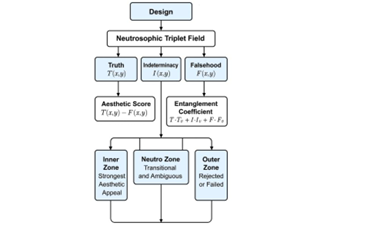
visually rejected zones. This paper proposes a novel neutrosophic triplet field model that
quantifies the aesthetic quality of design outputs using three independent components:
degree of visual truth (T), perceptual indeterminacy (I), and aesthetic failure (F). The
model draws on principles from the Neutrosophic Magnetic Field to define spatial zones
of influence and incorporates a partially-observed field response inspired by
Neutrosophic Quantum Theory. Mathematical functions define each component across a
design surface, and several equations are derived to compute zone-specific values. A fully
calculated case study on a discretized design space demonstrates the model's ability to
detect and differentiate visually ambiguous zones. Results show the importance of
transitional zones where indeterminacy peaks as key contributors to nuanced aesthetic
perception. This model offers a rigorous, quantifiable, and human-relevant framework for
analyzing artistic quality in CAAD systems.
Downloads
Downloads
Published
Issue
Section
License
Copyright (c) 2025 Neutrosophic Sets and Systems

This work is licensed under a Creative Commons Attribution 4.0 International License.