
A Hybrid Probabilistic-Neutrosophic Adaptive Convergence Model for Analyzing Innovative Performance of Agricultural Technology Enterprises in the Digital Economy
Keywords:
Neutrosophic normed space; hybrid probabilistic convergence; adaptive statistical convergence; agricultural innovation; digital economy; rough ideal convergence; uncertainty modeling.Abstract
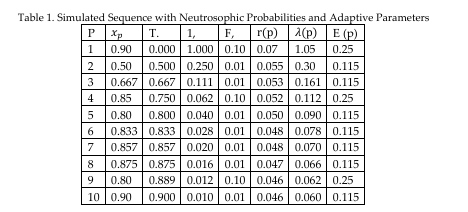
This paper introduces a novel mathematical framework that integrates hybrid
probabilistic-neutrosophic logic with adaptive rough ideal statistical convergence (AR-I
st) to model and analyze the dynamic performance of innovative agricultural technology
enterprises within the digital economy. Unlike classical convergence approaches, the
proposed model operates within a neutrosophic normed space (NNS) that accounts for
truth, indeterminacy, and falsity dimensions, enabling the representation of complex,
uncertain, and partially known data. By embedding a tri-valued probabilistic
distribution—comprising the likelihood of growth (T), uncertainty (I), and decline (F) we
define a new form of convergence, namely Hybrid Probabilistic-Neutrosophic
Convergence (HPNC). Simultaneously, we formulate adaptive mechanisms for the
convergence parameters r,λ,ϵ r, allowing the model to dynamically respond to evolving
enterprise behavior over time. Applied to the context of digital agricultural innovation
firms, our framework captures the non-linear and uncertain trajectories of technological
diffusion, resource allocation, and innovation stability. The resulting model is not merely
theoretical but structurally mirrors the adaptive complexity of real-world agri-tech
ecosystems. Key properties such as closedness, convexity, and boundedness of the
convergence sets are proven, establishing the robustness of the approach.
Downloads
Downloads
Published
Issue
Section
License
Copyright (c) 2025 Neutrosophic Sets and Systems

This work is licensed under a Creative Commons Attribution 4.0 International License.