
A Multi-Expert, Multi-Criteria Approach to the Neutrosophic Fuzzy Assignment Problem
Keywords:
Neutrosophic sets, Fuzzy assignment, Multi-expert, Multi-criteria, Aggregation, DefuzzificationAbstract
Assignment problems are a critical component in fields such as resource allocation,
scheduling, logistics, and workforce management, where tasks need to be optimally assigned to
workers, resources, or locations based on multiple criteria. Traditional assignment approaches,
including classical and fuzzy methods, often fall short when faced with uncertain, contradictory, or
indeterminate data. These challenges become more pronounced when the data comes from multiple
experts or criteria, each with varying degrees of certainty. In such scenarios, the ability to incorporate
and model uncertainty, while still producing reliable solutions, is essential for achieving meaningful
results.
The motivation behind this study is to address the shortcomings of existing methods by providing a
robust framework capable of handling uncertain, incomplete, and even conflicting information from
diverse sources. Specifically, we propose a multi-expert, multi-criteria neutrosophic fuzzy
assignment framework that leverages single-valued neutrosophic sets (SVNS) to represent and
manage three distinct components of uncertainty: truth, indeterminacy, and falsity. These
components allow for a more nuanced representation of information in worker–task assignment
problems, where each assignment is characterized by varying degrees of truth (certainty),
indeterminacy (lack of clarity), and falsity (inaccuracy or contradiction).
The novelty of the proposed method lies in its ability to aggregate and integrate information from
multiple experts and criteria in a systematic and effective manner. We introduce a custom-designed
aggregator that unifies the triple membership values (truth, indeterminacy, falsity) from each expert
and criterion into a single, cohesive representation of each worker-task pair. This integration is crucial
for dealing with the heterogeneity of expert opinions and the complex nature of multi-criteria
decision-making problems.
Furthermore, to make this approach practical and actionable, we define a defuzzification strategy
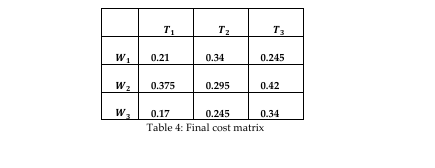
that transforms the neutrosophic fuzzy data into a definitive assignment matrix. This matrix can then
be solved using standard optimization methods, ensuring that the solution is both theoretically sound
and computationally feasible. By incorporating this step, the framework not only provides a more
flexible way of handling uncertainty but also ensures that the results are applicable in real-world
scenarios.
To illustrate the effectiveness and applicability of our proposed model, we present a detailed case
study along with several synthetic examples. These demonstrate how the proposed framework can
manage complex, contradictory, and uncertain data more effectively than simpler fuzzy approaches.
Through comparative analysis, we show that the neutrosophic fuzzy model significantly outperforms traditional methods, providing more accurate and reliable assignment decisions in the
presence of conflicting or incomplete information.
The primary contributions of this study are:
1. A novel multi-expert, multi-criteria neutrosophic fuzzy framework for assignment
problems that incorporates uncertainty from multiple sources.
2. An aggregator mechanism that efficiently combines the opinions of different experts and
criteria, addressing the challenges of conflicting or incomplete data.
3. A defuzzification strategy that converts the neutrosophic fuzzy data into a usable
assignment matrix.
4. Demonstrated effectiveness through case studies and synthetic examples, highlighting the
superior performance of the proposed method in comparison to classical fuzzy approaches.
Overall, this study provides a comprehensive and innovative solution to complex assignment
problems, demonstrating the potential of neutrosophic fuzzy approaches in handling uncertainty
and contradiction across diverse domains.
Downloads
Downloads
Published
Issue
Section
License
Copyright (c) 2025 Neutrosophic Sets and Systems

This work is licensed under a Creative Commons Attribution 4.0 International License.