
Measuring the degree of agreement between teachers' and employers' perceptions of the pedagogical model, using plitogenic statistics
Keywords:
Pedagogical management, Work practice, Systemic model, Vocational training, Ecuador, Teachers, Companies, plithogenic statistics, Plithogenic probabilityAbstract
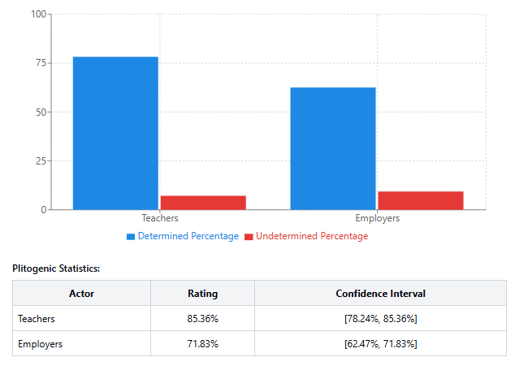
The systemic model of pedagogical management in the professional training of administrators of Instituto Superior Tecnológico Bolivariano de Tecnología (Ecuador) is assessed based upon the controversial findings of teachers and employers. The authors applied plithogenic statistics to quasi-measure the consensus/controversy between perceptions and triangulated data (interview with professors, survey with students and employers). It seems the significant controversy suggests that 1) systematic pedagogical management does not exist; 2) there's no pedagogical connection between university and enterprises; 3) teachers are not certified in innovative methodologies. Thus, a systematic model is recommended that relies upon strategic assessments to ensure vocational training relative to the productive sector's actual needs, providing administrators' vocational opportunities and externships and equipping them with analytical, critical thinking skills to minimize time spent recalling the company later on.
Downloads
Downloads
Published
License
Copyright (c) 2025 Neutrosophic Sets and Systems

This work is licensed under a Creative Commons Attribution 4.0 International License.