
Structural equilibrium in universities: quality, finance and sustainability from an empirical perspective: An integrative analysis with neutrosophic cognitive maps
Keywords:
Multivariate Analysis, Financial Health, Educational Quality, Higher Education, Institutional Sustainability, HJ- Dynamic Biplot, Panel Models, Neutrosophic Cognitive MapsAbstract
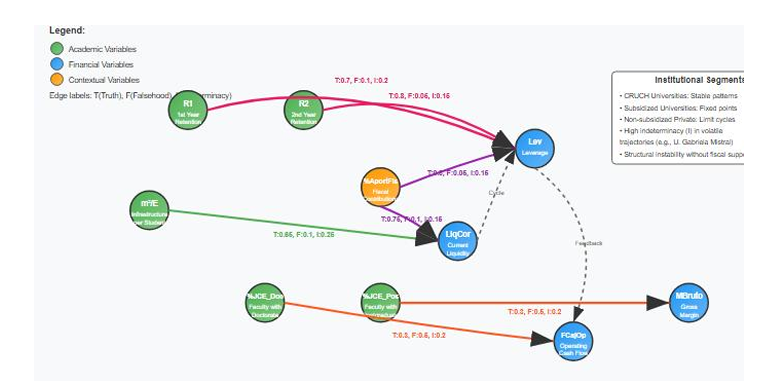
This study explores the structural relationships between institutional financial health and academic quality in Chilean higher education institutions (HEIs) by applying multivariate tools such as the dynamic HJ- Biplot and fixed-effects regression models for panel data, complemented by neutrosophic cognitive maps (NCMs). Using data from the 2016–2023 period, differentiated institutional trajectories are analyzed based on their membership in free tuition policies, university type (CRUCH, private), and financial structure. The results show that variables such as student retention, physical infrastructure, and academic training significantly influence key financial indicators such as liquidity, leverage, and operating margin. NCMs reveal degrees of indeterminacy in these relationships, especially in contexts of high uncertainty such as private universities not affiliated with free tuition. Specific patterns of vulnerability are identified in these institutions, and the stabilizing role of fiscal contributions is confirmed. Research shows that quality and financial sustainability are interdependent dimensions, whose coordination, analyzed from a neutrosophic perspective, is key to strengthening educational well-being and the resilience of the university system in contexts of change.

Downloads
Downloads
Published
License
Copyright (c) 2025 Neutrosophic Sets and Systems

This work is licensed under a Creative Commons Attribution 4.0 International License.