
Innovative Neutrosophic Models for Comprehensive Quality Assessment in University Law Courses: Conceptual Precision, Ethical Judgment, and Applied Competence
Keywords:
Neutrosophic logic, legal education quality, rough neutrosophic sets, bipolar neutrosophic cubic sets, interval neutrosophic model, legal ethics, applied legal competence, law course evaluation, uncertainty modeling, moot court assessment.Abstract
This research presents three original models to evaluate the quality of university law
courses from different perspectives. The first model uses a Double-Boundary Rough
Neutrosophic Set to measure how clearly students understand legal concepts. The second
model applies Bipolar Neutrosophic Cubic Logic to assess students’ ethical thinking and
their ability to avoid legal bias. The third model introduces a Multi-Valued Interval
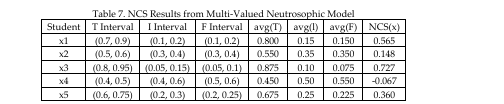
Neutrosophic Competence Score (NCS), designed to measure students’ ability to apply
law in real legal situations like moot courts. Each model is supported by full mathematical
definitions, equations, and calculated examples. Together, they give a deep and balanced
view of legal education qualitycombining legal understanding, ethical clarity, and applied
legal skills. The models also offer practical value for teachers and curriculum designers
by showing how to identify student needs and improve legal training methods. This study
proves that using neutrosophic logic in education can offer detailed, human-centered
evaluation tools for complex fields like law.
Downloads
Downloads
Published
Issue
Section
License
Copyright (c) 2025 Neutrosophic Sets and Systems

This work is licensed under a Creative Commons Attribution 4.0 International License.