Neutrosophic Hyper-Distributions for Modeling Teaching Reform and Practice Efficiency Analysis of University Thought and Political Curriculum in Digital Education Environments
Keywords:
Digital Education; Political Orientation; Thought Formation; Neutrosophic Hyper-Distributions; Multi-layered Uncertainty; Cognitive Modeling; Political Polarization; Educational Analytics.Abstract
This study applies the Neutrosophic Hyper-Distribution (NHD) framework to
model thought and political orientation in digital education environments. NHDs extend
classical probability and neutrosophic logic by embedding full neutrosophic distributions
within each truth (T), indeterminacy (I), and falsehood (F) component, enabling the
capture of layered uncertainties and internal contradictions in belief structures. We
formalize the Neutrosophic Hyper-Probability Density Function (NHPDF) and derive
associated measures Hyper-Expectation, Hyper-Variance, and Hyper-Entropy—then
apply them to a 12-week online political science course comparing moderated and
unmoderated discussion groups. Data from weekly stance surveys, certainty ratings, and
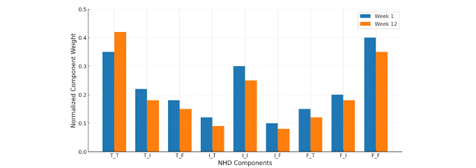
text analysis of discussion posts are mapped to NHD components. Results show that
moderation supports a mild positive stance shift, reduces opinion variance, and lowers
hyper-entropy, indicating more coherent and stable beliefs. In contrast, unmoderated
discourse increases both variance and entropy, reflecting greater indecision and
fragmentation. These findings demonstrate the value of NHDs as a quantitative tool for
capturing the multi-layered cognitive and political effects of discussion strategies, offering
educators a means to foster balanced and resilient political thinking in digital learning
contexts.
Downloads
Downloads
Published
Issue
Section
License
Copyright (c) 2025 Neutrosophic Sets and Systems

This work is licensed under a Creative Commons Attribution 4.0 International License.