
Neutrosophic Network Flow with Truth, Indeterminacy, and Falsity Capacities: An Innovative Mathematical Framework for Efficiency Evaluation of Achievement Transformation of College Student Innovation and Entrepreneurship Training Programs
Keywords:
Neutrosophic logic; Network flow; Truth–indeterminacy–falsity capacities; Optimization under uncertainty; Max-flow/min-cut extension; Innovation training; Entrepreneurship education; Neutrosophic probability; Educational network design; Flow-based decision making.Abstract
This paper introduces a new mathematical framework that combines neutrosophic logic
and network flow theory to improve the design of student innovation and
entrepreneurship training programs. In the proposed approach, each connection in the
training process is represented as a directed edge with three separate capacities: truth,
indeterminacy, and falsity. These capacities describe how much confirmed learning,
uncertainty, and failure can pass between stages of the program. By applying
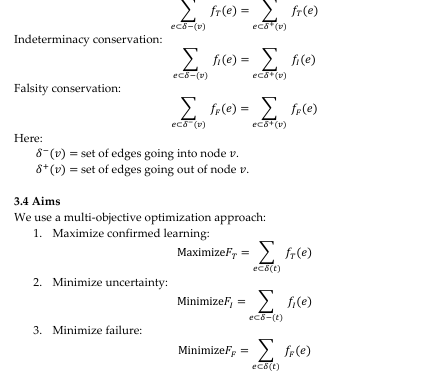
conservation rules for each component and adapting classical flow optimization methods,
we can identify training paths that increase confirmed learning while reducing
uncertainty and limiting the spread of failure. The framework also extends the max
flow/min-cut theorem to the neutrosophic setting, allowing rigorous analysis under
incomplete or contradictory data. A fully worked case study with synthetic student data
shows how the model can guide curriculum adjustments, demonstrating measurable
improvements in training effectiveness. This work opens a new research direction by
linking neutrosophic probability with flow networks, offering a versatile tool for decision
making in complex educational systems.
Downloads
Downloads
Published
Issue
Section
License
Copyright (c) 2025 Neutrosophic Sets and Systems

This work is licensed under a Creative Commons Attribution 4.0 International License.