
A Plithogenic–Neutrosophic Carbon Budget and Contradiction Model for Sustainable Logistics Enterprises under Carbon Peak and Neutrality Targets
Keywords:
Green Logistics; Dual Carbon Goals; Plithogenic Set Theory; Neutrosophic Measure; Neutrosophic Integral; Plithogenic Probability; Carbon Budget Constraint; Sustainability Optimization; Contradiction Degree; Environmental Performance Uncertainty.Abstract
The achievement of dual carbon goals carbon peaking followed by carbon
neutrality demands decision frameworks that can simultaneously address multi-attribute
contradictions and uncertainty in environmental performance data. This paper introduces
the Plithogenic–Neutrosophic Dual-Carbon Green Flow (PN-DCGF) model, a novel
mathematical methodology that fuses plithogenic set theory with neutrosophic measure,
integral, and probability to optimize green logistics strategies under complex
sustainability constraints. Plithogenic operators aggregate performance attributes, such as
emission reduction, cost variation, renewable energy share, and policy compliance, while
explicitly weighting the contradiction degree of each attribute value relative to a dominant
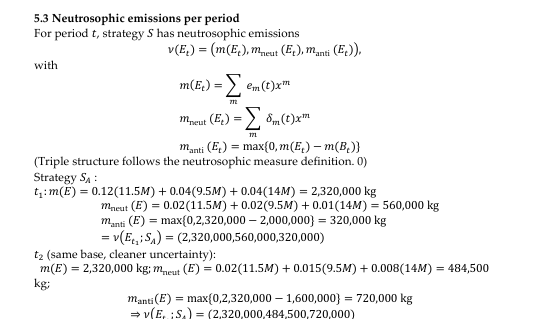
sustainability value. Neutrosophic measures express carbon budgets as ordered triples
determinate allowance, indeterminate margin, and determinate overshoot and
neutrosophic integrals compute compliance momentum over policy windows with
uncertain limits or values. Plithogenic probability is employed to model multiple
likelihoods of operational outcomes conditioned on attribute values. The framework
enforces a dual-goal feasibility envelope, ensuring that neutrosophic emissions never
exceed the carbon budget triple according to monotonicity and additivity rules. A fully
calculated case study on a multimodal freight network illustrates the model’s capacity to
rank strategies, quantify compliance under uncertainty, and evaluate scenario-based goal
attainment. Results demonstrate that PN-DCGF provides a rigorous, contradiction-aware,
and uncertainty-resilient decision basis for sustainable logistics planning aligned with
carbon peaking and neutrality objectives.
Downloads
Downloads
Published
Issue
Section
License
Copyright (c) 2025 Neutrosophic Sets and Systems

This work is licensed under a Creative Commons Attribution 4.0 International License.