
Neutrosophic Statistical Analysis of Temperature and Precipitation Variability over Four Decades in the City of Pucallpa, Peru
Keywords:
Temperature variability, precipitation variability, Mann-Kendall test, Spearman correlation, ENSO, Neutrosophic Statistics, NeutrosophyAbstract
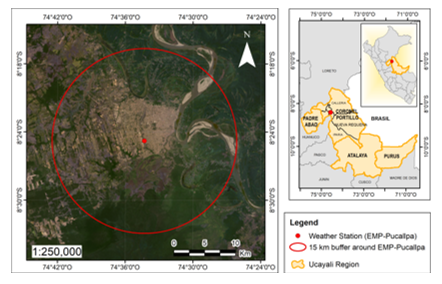
This study analyses the spatiotemporal variation of temperature and rainfall in Pucallpa (1984-2024) and its relationship with El Niño and La Niña phenomena and urban expansion. Monthly meteorological data from the UNU-SENAMHI station, weather, ENSO indices, and Landsat imagery were used to calculate the Normalized Difference Vegetation Index (NDVI) as an indicator of vegetation cover. Missing data were processed through interpolation, and linear regression analysis, the Mann-Kendall test, and Spearman correlation adapted to interval-valued data were applied to evaluate trends and statistical associations. Our findings highlight the combined influence of global climatic factors and local transformations on the microclimate of Pucallpa. To reach our conclusions, we used Neutrosophic Statistics as a study tool. This theory extends classical statistics when there are interval-based data or parameters, or when the population size is imprecise. Neutrosophic Statistics can improve accuracy by capturing the indeterminacies that exist in measurements. This tool allows us to assess changes in temperature and precipitation during the year, which are not homogeneous throughout the region. Specifically, we use intervals of maximum and minimum temperatures during the month.

Downloads
Downloads
Published
License
Copyright (c) 2025 Neutrosophic Sets and Systems

This work is licensed under a Creative Commons Attribution 4.0 International License.