
Designing Optimal Routes for Mobile Prenatal Care Clinics Using Neutrosophic Cognitive Maps
Keywords:
Optimal route design, mobile clinics, prenatal care, Neutrosophic Cognitive Maps, maternal health, access to health, uncertainty, Ecuador, rural areasAbstract
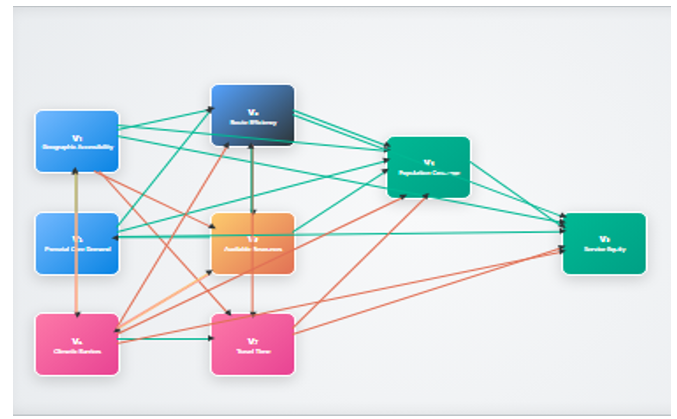
This manuscript examines the routing of mobile prenatal clinics in Ecuador, focusing on maternal and infant health in vulnerable, hard-to-reach areas. This assessment is significant because even with new developments geographically expanding access to mobile prenatal clinics, there remain accessibility gaps for vulnerable women located in hard-to-reach, topographic regions where it's uncertain if they truly need services or can assess whether they can travel to a clinic. While previous studies sought to assess the potential for newly mobile units and coverage, few studies have been found to assess new routes through accessibility uncertainty and villages with varying demand for access to clinics based on fluctuating prenatal needs. Therefore, this project will incorporate a novel approach called Neutrosophic Cognitive Maps to determine causal relationships among villages, accessibility challenges through geography, and the prevalence of need through access over time. Results show the strengths and weaknesses of interconnectivity, some females who cannot access a clinic, and other metrics that suggest a new way of assessing routing that is not only more effective but fairer in terms of access. Ultimately, this study contributes to existing literature by providing an avenue for real-life health service routing endeavors amidst uncertainty and practical implications for decentralizing routes over time, providing access to potential prenatal care that could change the course of maternal and infant health in Ecuador.

Downloads
Downloads
Published
License
Copyright (c) 2025 Neutrosophic Sets and Systems

This work is licensed under a Creative Commons Attribution 4.0 International License.