
Multivariate visualization of the impact of Universal Design for Learning on inclusion and mathematical achievement using the Neutrosophic Biplot Method
Keywords:
UDL, Inclusion, Mathematics, Academic Performance, Neutrosophic Biplot, Ecuadorian Education, Multivariate AnalysisAbstract
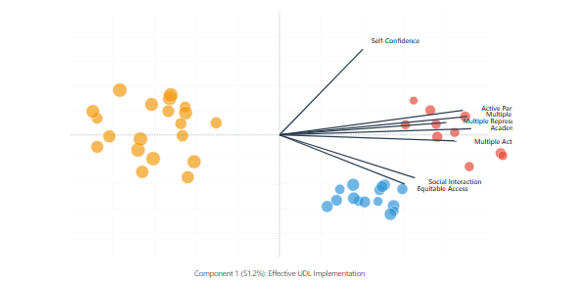
This dissertation answers a problem of practice. What is the effect of Universal Design for Learning on equity and achievement in math for at-risk and special needs upper elementary and secondary students in Ecuador? classrooms are more diverse than ever, with variations in learning styles and the expectation of equity in the classroom. Thus, it's critical to address past and present methods of teaching that promote access and participation. While the implementation of Universal Design for Learning is relatively new to the inclusion game, the studies done thus far fail to incorporate a triangulated design that considers complexity, multivariate factors, and the uncertainty of the educational environment. Therefore, the use of the Neutrosophic Biplot Method was employed to assess participation and achievement in math based on an uncertain event via a multivariate analysis. The action created a heat map of inclusion and achievement that suggested statistically significant relationships between how adopting UDL promotes equity and achievement in math, but also a difference, within regions, gender, age, and disability status. The contribution of this study is the unique methodological approach that combines inclusive pedagogy with a neutrosophic study that bolsters the body of theory and pragmatism in the field of education from a diverse situational view.

Downloads
Downloads
Published
License
Copyright (c) 2025 Neutrosophic Sets and Systems

This work is licensed under a Creative Commons Attribution 4.0 International License.