
A Neutrosophic Soft Set-Based Approach for Anemia Diagnosis: Managing Uncertainty in Medical Decision-Making
Keywords:
Neutrosophic Soft Sets; Anemia Diagnosis; Medical Decision-Making; Uncertainty Management; Neutrosophic Set TheoryAbstract
Fuzzy sets, introduced by Lotfi A. Zadeh in 1965, have been widely used to solve real
world problems involving uncertainty and ambiguous situations. However, traditional fuzzy sets
and interval-valued fuzzy sets are insufficient to fully capture uncertainty. To address this problem,
intuitionistic fuzzy sets and neutrosophic sets have been proposed. Neutrosophic sets, especially
neutrosophic soft sets, provide an effective framework for dealing with uncertain, conflicting, and
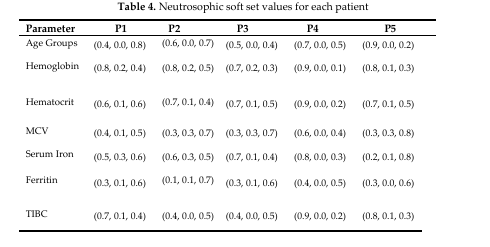
incomplete information, especially in medical decision making. In this study, a model for the
diagnosis of anemia is developed using the Neutrosophic Soft Set (NSS) method. The model scores
female patients according to age groups (15-44, 45-59, 60+) and several hematological parameters
such as hemoglobin level (Hb), hematocrit (Hct), mean corpuscular volume (MCV), serum iron
level, ferritin, and total iron binding capacity (TIBC). A more robust and accurate decision-making
process is created by assigning neutrosophic values to each parameter, including accuracy,
uncertainty, and inaccuracy values. Data for the model were obtained from patients treated in the
hematology clinic of a full-fledged hospital in Turkey. Smarandache stated that neutrosophic
clusters have a superior ability to deal with uncertainty, inconsistency, and missing data. This
approach offers significant advantages, especially in medical decision-making processes, where
uncertainty and contradiction are intense. Maji's method, based on the theory of neutrosophic soft
sets, has yielded effective results in increasing the accuracy and consistency of medical diagnoses.
Used in the diagnosis of anemia and similar diseases, this approach is a valuable tool in the
evaluation of uncertain data. This paper aims to provide a guide to the application of neutrosophic
soft sets in medical decision-making. It also highlights the potential of these approaches to improve
decision support systems in medical diagnostics and provides recommendations for future research.
Downloads
Downloads
Published
Issue
Section
License
Copyright (c) 2025 Neutrosophic Sets and Systems

This work is licensed under a Creative Commons Attribution 4.0 International License.