
Refined Neutrosophic Set approach for Musculoskeletal disorders
Keywords:
Musculoskeletal disorders, Rheumatoid Arthritis, Osteoarthritis, Lupus, Bursitis, Neutrosophic set, Neutrosophic Refined set, Dimension, Hamming distance, Normalised hamming distance, Euclidean dis tance, Normalised euclidean distance, Correlation MeasureAbstract
Musculoskeletal disorders are often characterized by persistent joint pain, stiffness, swelling, and
reduced mobility, which can severely impact daily functioning and quality of life. These conditions often present
overlapping symptoms, making accurate diagnosis a significant challenge in clinical settings. Traditional di
agnostic approaches may struggle with the inherent uncertainty, vagueness, and imprecision found in medical
data. This paper proposes a novel approach for classifying four musculoskeletal disorders using the Neutro
sophic Refined Set framework, with a particular focus on correlation and distance-based measures. Neutrosophic
Refined Set, an advanced extension of neutrosophic logic, provides a robust mathematical model for handling
indeterminate and inconsistent information, making it particularly well-suited for healthcare applications.
The proposed work is illustrated with four musculoskeletal disorders- Rheumatoid Arthritis, Osteoarthritis,
Lupus, Bursitis and the eight associated Rheumatic symptoms. Correlation analysis is employed to determine
the most prevalent symptom group associated with each disorder. Also, the distance measures- Hamming
distance, Normalized Hamming distance, Euclidean distance, and Normalized Euclidean distance are used to
compute the proximity of four patient cases to each disorder. Python implementation of the proposed method is
used to streamline the computational process, offering a faster, more accurate, and less error-prone alternative
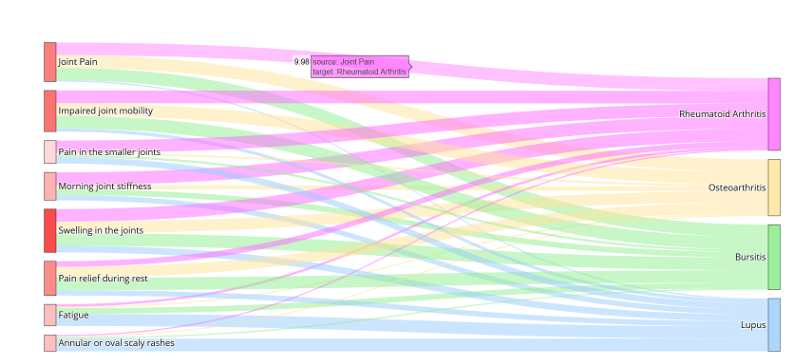
to manual calculations. Also, highly informative visualizations are employed to illustrate the general trends in
symptom intensity and distribution across the four musculoskeletal disorders. Overall, this approach demon
strates the potential of Neutrosophic Refined Sets in enhancing diagnostic accuracy, managing uncertainty, and
supports clinical decision-making.
Downloads
Downloads
Published
Issue
Section
License
Copyright (c) 2026 Neutrosophic Sets and Systems

This work is licensed under a Creative Commons Attribution 4.0 International License.