
A Neutrosophic Rayleigh Approach Based on DUS- Transformation for Analysing COVID-19 Incubation Periods
Keywords:
Neutrosophic; DUS transformation; Probability distribution; Rayleigh distributionAbstract
The DUS transformation to the Rayleigh distribution introduces better modelling of real
world variations and enhances its ability to represent skewed or heavy-tailed data. To address
ambiguity, inconsistency, and indeterminacy in data, In this study, we introduce an extension of
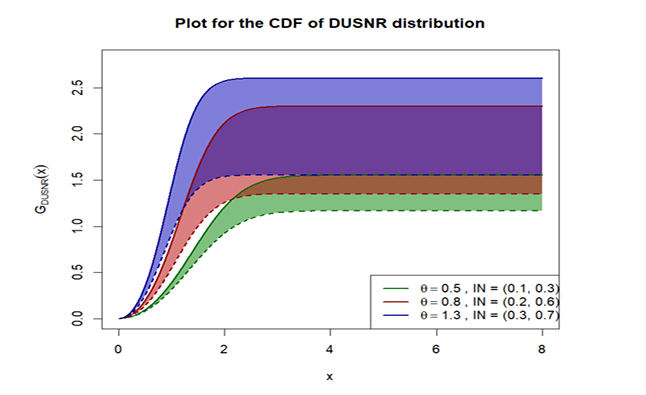
the neutrosophic Rayleigh distribution, the DUS Transformed Neutrosophic Rayleigh (DUSNR)
Distribution. Important statistical aspects of the DUSNR distribution, such as quantiles, moments,
moment-generating functions, and order statistics, are determined under neutrosophic conditions.
The performance of the maximum likelihood estimator is assessed by simulation, showing that its
accuracy increases as sample sizes rise. Lastly, the findings of applying the suggested distribution
to the COVID-19 incubation dataset are contrasted with those of the DUS transformed Rayleigh
distribution and the neutrosophic Rayleigh distribution.
Downloads
Downloads
Published
Issue
Section
License
Copyright (c) 2026 Neutrosophic Sets and Systems

This work is licensed under a Creative Commons Attribution 4.0 International License.