
Mathematics Education and Its Contributions to Attention Deficit Hyperactivity Disorder
Keywords:
Mathematics education; ADHD; Mathematical problem solving; predictors of failure; Neutrosophic logic; Indeterminacy.Abstract
This research presents a systematic review of studies in mathematics education and
problem-solving that address pedagogical work with children with a diagnosis of attention deficit
and hyperactivity disorder. Through a historical-logical methodological analysis and a rigorous
bibliographic search, significant contributions to the development of mathematical learning in this
population were identified. The study highlights the main predictors of difficulties in mathematical
performance, associated behavioral aspects, effective pedagogical models, and successful cases and
didactic strategies that have shown significant progress, particularly in teaching through
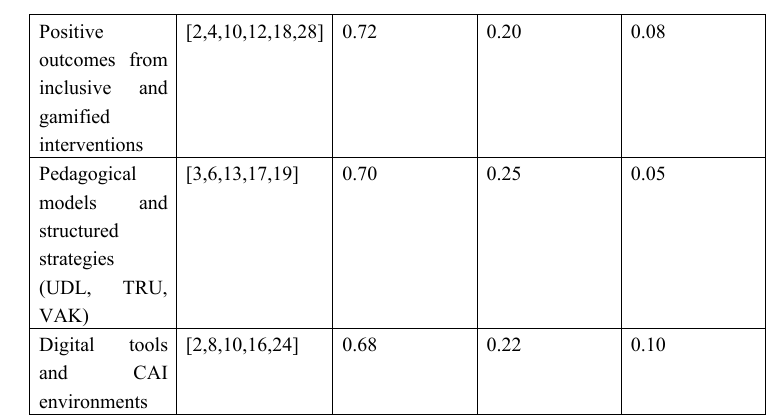
mathematical problem-solving. Additionally, a neutrosophic logic framework was applied to assess
the degree of certainty, indeterminacy, and contradiction within each evidence category, providing
a tripartite epistemic characterization of the reviewed literature.
Downloads
Downloads
Published
Issue
Section
License
Copyright (c) 2026 Neutrosophic Sets and Systems

This work is licensed under a Creative Commons Attribution 4.0 International License.