
Applied Neutrosophic Triplets in AI Decision Systems: Introduction to an Ongoing Case Study Across Agentic, Swarm, RAG, and Pipeline Architectures
Keywords:
Neutrosophy; neutrosophic logic; truth-indeterminacy-falsity; artificial intelligence; RAG evaluation; multi-agent systems; swarm governance; hallucination control; memory recall; anti-drift testing; ternary information systems; Python; Rust; cybersecurity; quantum-oriented software research.Abstract
Modern artificial intelligence systems frequently compress decision state into a scalar confidence value, a binary pass/fail flag, or an averaged evaluation metric. This compression is convenient for APIs, dashboards, and automated thresholds, but it is often mathematically and operationally insufficient. A generated answer can be supported by one source, contradicted by another, and still leave unresolved context. A worker in a multi-agent system can complete a task while omitting critical evidence. A retrieval pipeline can return a high lexical score while failing to provide semantic support. A human-in-the-loop system can approve execution only after modification, which is neither pure acceptance nor pure rejection.
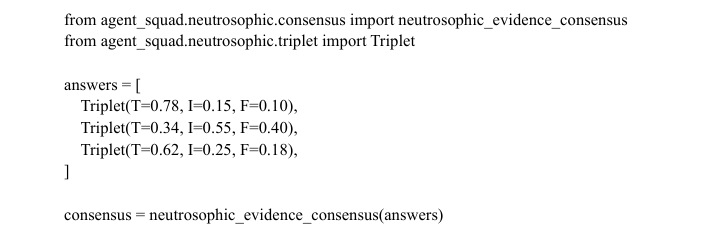
This paper introduces an ongoing applied research program that translates Florentin Smarandache's neutrosophic dimensions, Truth, Indeterminacy, and Falsity (T/I/F), into real Python AI software surfaces. The work studies four public or public-facing case studies: Agent Squad, Aden/Hive, Ragas, and Haystack. The objective is not to impose a universal neutrosophic subsystem on unrelated projects. The objective is to determine whether a small, testable, maintainer-safe neutrosophic primitive can be adapted to each host architecture without breaking its contracts.
The central preliminary finding is that the indeterminacy dimension I is the most informative part of the triplet, but also the least portable. In Agent Squad, I will represent routing ambiguity and unresolved response fusion. In Aden/Hive, I will represent incomplete, blocked, or contradictory worker reports. In Ragas, I will represent missing, ambiguous, or insufficient evidence for a generated answer. In Haystack, I will appear across evaluator row status, retrieval confidence, and human-in-the-loop decision semantics.
The same mathematical symbol does not keep the same engineering shape across host systems. The research will therefore treat neutrosophy as a translation discipline between mathematics and software contracts. Each architecture will be instrumented locally, even when maintainers have not yet accepted an upstream contribution. Daily and weekly tests will be used to observe trace formation, memory recall, anti-drift behavior, evaluator stability, and the evolution of AI behavior under the same local model conditions. Follow-up reports are planned for September 2026 and December 2026. The expected final goal is to obtain at least one complete public upstream implementation, and ideally several adapted implementations, while keeping the public article focused on reproducible project evidence.
Downloads
Downloads
Published
Issue
Section
License
Copyright (c) 2026 Neutrosophic Sets and Systems

This work is licensed under a Creative Commons Attribution 4.0 International License.