
Neutrosophic estimation of population variance using two auxiliary variables in simple random sampling
Keywords:
Mean square error; Neutrosophic framework; Variance estimation; Auxiliary variables; EfficiencyAbstract
In survey sampling, the efficient estimation of population variance plays an important role in draw
ing inference, particularly when handling uncertainty and imprecise data. This article develops a generalized
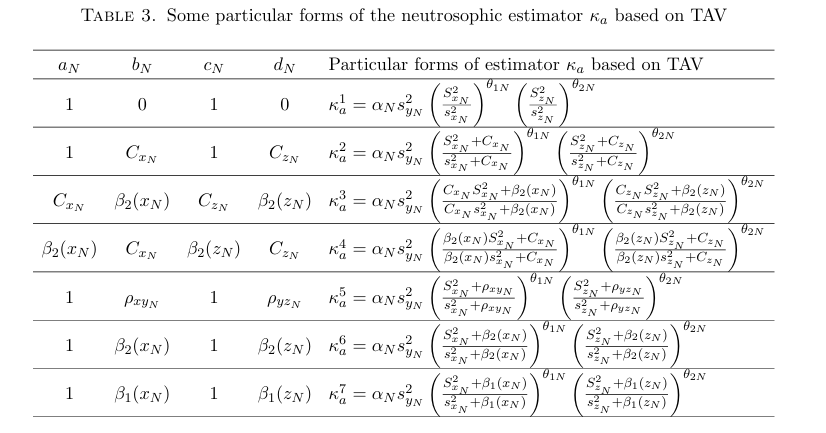
class of Searls type power ratio estimators for the population variance under a neutrosophic framework, incor
porating two auxiliary variables (TAV) in simple random sampling (SRS). The proposed approach accounts
for indeterminacy and imprecision that frequently arise in real-world data collection processes by utilizing neu
trosophic representation of both study and auxiliary variables. By simultaneously employing two auxiliary
variables, the efficiency of the proposed variance estimators is significantly improved over some basic adapted
neutrosophic population variance estimators. Theoretical properties of the proposed estimators, including bias
and mean square error (MSE), are derived under the neutrosophic setup. A comparative performance evalua
tion is conducted using both simulated and real-world datasets, demonstrating the superiority of the proposed
estimators in terms of efficiency, especially in uncertain data.
Downloads
Downloads
Published
Issue
Section
License
Copyright (c) 2026 Neutrosophic Sets and Systems

This work is licensed under a Creative Commons Attribution 4.0 International License.