
A Linguistic Neutrosophic TOPSIS Framework for Sustainable Biomass Composite Selection
Keywords:
linguistic neutrosophic numbers, TOPSIS, multi-criteria decision-making, FDM 3D printing, biomass composites.Abstract
The valorization of agricultural waste biomass as functional filler in FDM 3D printing composites
represents a tangible contribution towards sustainable additive manufacturing and circular economy
synergism. Choosing the right composite for FDM is difficult because there are a number of technical,
economic and environmental criteria which conflict. Further, experts do not have complete certainty about
any of the criteria. The indeterminacy level that characterises experts’ judgement on emerging and only
partially characterised materials cannot be independently quantified by classical fuzzy sets and intuitionistic
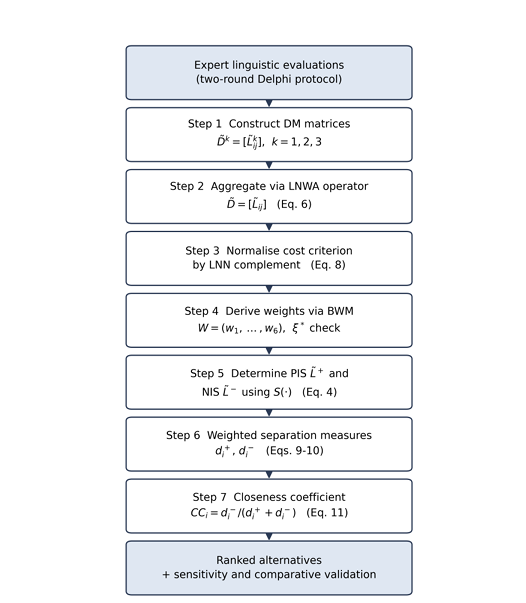
fuzzy sets. The present research proposes a Linguistic Neutrosophic TOPSIS (LN-TOPSIS) technique to
assess and rank five alternatives of agricultural waste biomass composite materials sourced from Tamil
Nadu like Sugarcane Bagasse/PLA (A1), Rice Husk Silica/ABS (A2), Coir Fibre/PHA (A3), Bamboo
Particle/Nylon (A4) and Groundnut Shell Powder/PETG (A5). The criteria entail six ones with technical,
environmental and economic dimensions. This includes Mechanical Performance (C1) index, Printability
(C2), Sustainability (C3), Raw material cost (C4), Regional availability (C5) and Surface quality (C6).
Criterion weights originating from the Best-Worst Method (BWM) are obtained with a consistency ratio of
0.027. Expert evaluations are carried out according to a two-round Delphi protocol and the Linguistic
Neutrosophic Weighted Averaging (LNWA) operator aggregates the panel judgements. Every language
assessment is tethered to published quantitative material property data to ensure transparency and
reproducibility. According to the analysis, Sugarcane Bagasse/PLA (A1) is the most preferred alternative
(CC=0.861), followed by Bamboo Particle/Nylon (A4, CC=0.744) and Rice Husk Silica/ABS (A2,
CC=0.518). Across all 36 systematic weight-perturbation scenarios, the ranking remains invariant, and in
a Monte Carlo simulation using 1000 Dirichlet-sampled weight vectors, A1 ranked first in 96.7 % of the
runs. The Spearman rank correlations between five existing MCDM methods are between 0.90 and 1.00.
It is as per literature available to us, this is one of the earliest applications of linguistic neutrosophic MCDM
to agriculture waste biomass composite for FDM 3D printing.
Downloads
Downloads
Published
Issue
Section
License
Copyright (c) 2026 Neutrosophic Sets and Systems

This work is licensed under a Creative Commons Attribution 4.0 International License.