Sexual Education and STI Prevention in High School: A Neutrosophic Analysis of the Opportunities and Risks of Generative Artificial Intelligence
Keywords:
Comprehensive sexuality education, sexually transmitted infections, generative artificial intelligence, neutrosophy, neutrosophic analysis, high school, school nursingAbstract
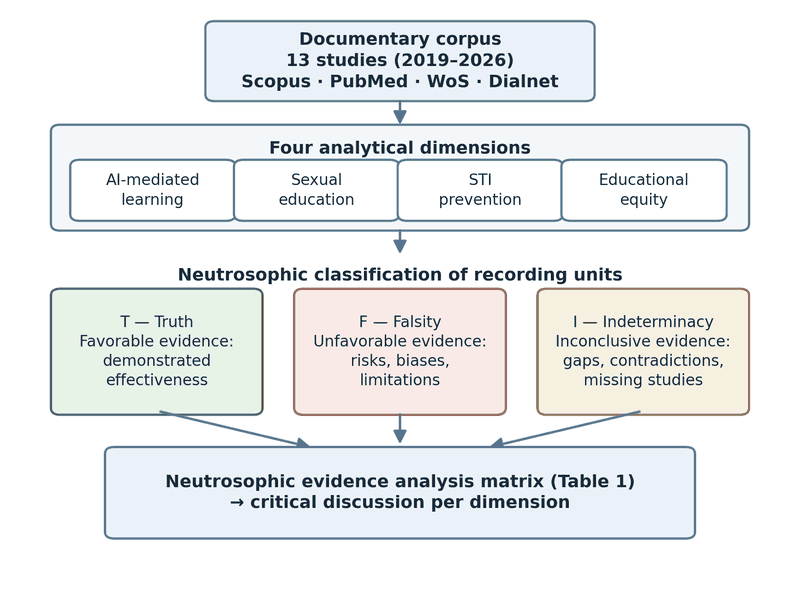
Sexually transmitted infections (STIs) remain a critical challenge during adolescence. Given the limitations of traditional sex education, generative artificial intelligence (GAI) has emerged as a personalized and anonymous consultation alternative. This study analyzes, from a neutrosophic perspective, the scientific evidence published between 2019 and 2026 on the use of GAI to strengthen STI prevention among high school students. Through a critical integrative review of thirteen reference studies, a matrix was built that classifies the findings across four dimensions (AI-mediated learning, sexual education, STI prevention, and educational equity) according to their truth (T), falsity (F), and indeterminacy (I) components, and was quantified through single-valued neutrosophic numbers following the evidence-synthesis approach of neutrosophic paraconsistent logic: the mean triplet over the four dimensions was ⟨0.54, 0.30, 0.37⟩ and, because the components are not constrained to sum to one, the analysis separates contradiction from absence of evidence: AI-mediated learning is the most contested dimension (min(T, F) = 0.50) and educational equity the most evenly divided (⟨0.40, 0.40, 0.40⟩). The results indicate that GAI facilitates anonymous, personalized, judgment-free access to preventive information (T), while documented risks of scientific inaccuracy (hallucinations), bias, and digital-divide exclusion persist (F). Indeterminacy (I) is concentrated in the absence of longitudinal evidence on the actual behavioral impact of these tools. We conclude that GAI should operate as a complementary resource, subordinated to teachers' pedagogical guidance and to the clinical validation provided by school nursing. DOI 10.5281/zenodo.22252335
Downloads
Downloads
Published
Issue
Section
License
Copyright (c) 2026 Neutrosophic Sets and Systems

This work is licensed under a Creative Commons Attribution 4.0 International License.