Breaking the Chains of Probability: Neutrosophic Logic as a New Framework for Epistemic Uncertainty in Large Language Models
Keywords:
neutrosophic logic; large language models; epistemic uncertainty; hyper-truth; uncertainty quantification; indeterminacy; ethical AI; plithogenic structureAbstract
Large Language Models (LLMs) are predominantly governed by probabilistic frameworks
in which the sum of outcome probabilities is constrained to unity. This limitation, often imposed by
Softmax layers, leads to a collapse of uncertainty that conflates ignorance, paradox, and vagueness.
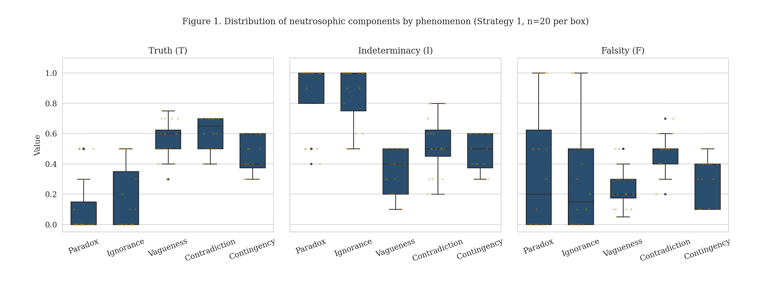
We present an empirical investigation of Neutrosophic Logic, in which Truth (T), Indeterminacy (I),
and Falsity (F) are three independent dimensions on [0, 1], applied to elicit declared epistemic states
from LLMs. Across 300 API calls — including 100 valid unconstrained neutrosophic evaluations —
on four OpenAI GPT models and five linguistic phenomena (five repetitions per cell), the
neutrosophic strategy yields hyper-truth (T + I + F > 1) in 66.0% of Strategy-1 evaluations, with the
highest rates observed in ethical contradiction (95%) and future contingency (70%). A Pearson chi
square test of phenomenon × hyper-truth association is significant (chi-square = 11.32, df = 4, p =
0.023). Mason (2026) independently replicated and extended an earlier release of this work across
five additional model families from five different vendors, reporting hyper-truth in 84% of
unconstrained evaluations. We do not claim that hyper-truth is an intrinsic latent variable inside the
model; rather, that unconstrained neutrosophic prompting elicits declared epistemic states that
probabilistic prompting structurally suppresses by Proposition 1.
Downloads
Downloads
Published
Issue
Section
License
Copyright (c) 2026 Neutrosophic Sets and Systems

This work is licensed under a Creative Commons Attribution 4.0 International License.