
Responsible AI for Text Classification: A Neutrosophic Approach Combining Classical Models and BERT
Keywords:
Responsible AI, Neutrosophic Uncertainty, Text Classification, BERT, Ensemble LearningAbstract
Recent advances in natural language processing have seen remarkable improvements in
text classification tasks, largely driven by transformer-based architecture such as BERT. However,
deploying these models in real-world applications demands a focus on responsible artificial
intelligence (AI) for emphasizing transparency, uncertainty quantification, and interpretability to
foster trustworthiness. This study proposes an approach combining classical ensemble classifiers
(Logistic Regression, Random Forest, and Support Vector Classification) calibrated for probabilistic
outputs with BERT fine-tuning on the DBpedia 14-class dataset. Furthermore, we incorporate
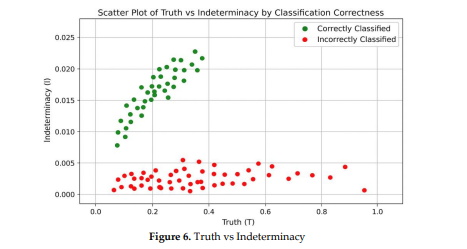
neutrosophic logic to quantify the uncertainty in predictions by calculating Truth (T),
Indeterminacy (I), and Falsity (F) measures from model output probabilities. Our classical
ensemble achieves an average accuracy of approximately 97.3%, while BERT fine-tuning attains
near-perfect accuracy (~99.8%) across the 14 balanced classes. The neutrosophic uncertainty
analysis reveals high confidence (high T, low I and F), with indeterminacy effectively identifying
ambiguous samples, highlighting areas for human review. These results underscore the utility of
combining classical and deep learning methods within a responsible AI framework, providing both
state-of-the-art performance and interpretable uncertainty quantification, crucial for trustworthy
deployment in sensitive applications.
Downloads
Downloads
Published
Issue
Section
License
Copyright (c) 2025 Neutrosophic Sets and Systems

This work is licensed under a Creative Commons Attribution 4.0 International License.