
A Neutrosophic Interpretation of the Island Rule: From the Tethys Ocean to Urban Gigantism in Freshwater Crabs
Keywords:
neutrosophic evolution, evolutionary biogeography, island rule, Potamon fluviatile, Tethys Ocean, freshwater crab evolution, ecological isolation, gigantism, subterranean ecosystems, urban evolutionary habitats.Abstract
This paper proposes an extension of the Neutrosophic Theory of Evolution into the field
of evolutionary biogeography. Using the freshwater crab Potamon fluviatile as a case study, we
analyze how evolutionary, involutionary, and indeterminate processes interact across geological,
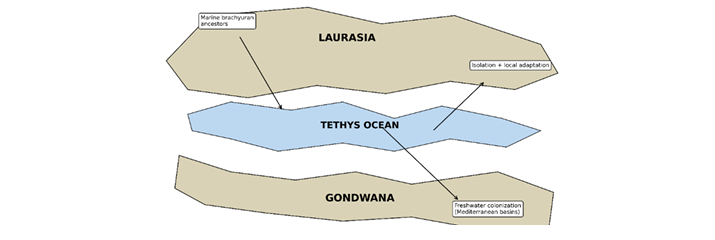
ecological, and spatial scales. The species originated from marine ancestors in the ancient Tethys
Ocean and later colonized freshwater ecosystems across the Mediterranean basin. A long-isolated
population inhabiting subterranean canals beneath the ruins of Rome exhibits unusual body size
and longevity, suggesting a form of island-like gigantism. We argue that such evolutionary
phenomena can be interpreted within a neutrosophic framework where adaptation involves
simultaneous processes of evolution, involution, and indeterminacy. This study represents the first
formal applications of neutrosophic theory to evolutionary biogeography.
Downloads
Downloads
Published
Issue
Section
License
Copyright (c) 2026 Neutrosophic Sets and Systems

This work is licensed under a Creative Commons Attribution 4.0 International License.