Neutrosophic Selective Separability
Abstract
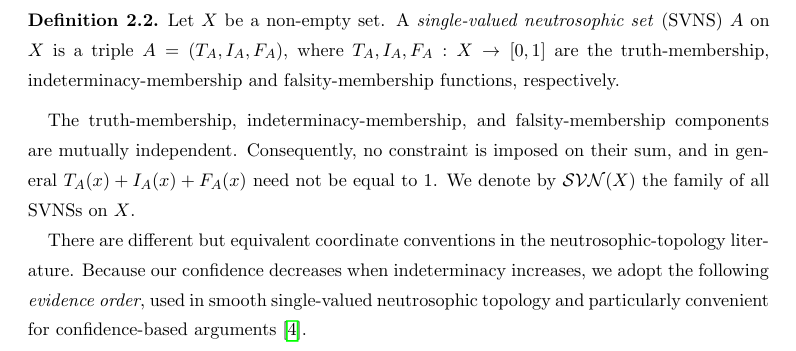
We develop a confidence-sensitive neutrosophic framework for selective separability. Single-valued
neutrosophic sets are evaluated through an admissible aggregation operator Φ(T,1 − I,1 − F), so that the
conservative minimum is only one possible choice. We first study uncertain dense data over an ordinary
topology and prove operator-independent transfer results for M-, H-, R-, and S-separability, while showing
that the admissible witnesses remain genuinely confidence-sensitive. We then pass to single-valued neutrosophic
topological spaces and distinguish strong intrinsic density, which reaches the full confidence height of every
effective open set, from weak intrinsic density, which only requires positive confidence overlap. The weak and
strong notions differ for individual neutrosophic sets, although both recover the expected classical space classes
on crisp-induced topologies. To keep countable network weight meaningful, we introduce countably calibrated
neutrosophic networks based on a dense rational set of point profiles. We also formulate both trace-based and
genuinely graded selection principles controlled by single-valued neutrosophic filters on the index set. Finally, we
compare the minimum and product confidence aggregators, discuss numerical resolution thresholds for intrinsic
selection, and derive consequences for Fr´echet–Urysohn and function spaces
Downloads
Downloads
Published
Issue
Section
License
Copyright (c) 2026 Neutrosophic Sets and Systems

This work is licensed under a Creative Commons Attribution 4.0 International License.